

My Page

Enjoy an udon restaurant — an illustrative dining scene

A practical food & restaurant guide

Enjoy an udon restaurant

A warm bowl or a cool plate.
Find your way around an udon shop.

✿ What you will learn ✿

Choose a noodle style, temperature and portion.
Learn how to order, use a self-service counter,
and check condiments and ingredients.

✿ Key points ✿

Enjoy an udon restaurant — an illustrative dining scene

✿ Contents ✿

  1. 1. Choose an udon style 〉
  2. 2. Order temperature & size 〉
  3. 3. Follow the self-service flow 〉
  4. 4. Add condiments gradually 〉
  5. 5. Eat comfortably & carefully 〉
  6. 6. Check broth & allergens 〉

✿ Frequently asked questions ✿

Q Do I have to slurp udon? +

No. Eat without slurping if you prefer. Take care with hot noodles and splashes, and choose a comfortable way to eat.

Q Should I take a seat before ordering at a self-service shop? +

It depends on the shop. Some ask you to find a seat first; others seat you after payment. Follow the entrance signs or ask staff.

Q Does vegetable udon contain no meat or fish? +

Vegetable toppings do not tell you what is in the broth, sauce or seasonings. Explain what you avoid and ask about shared cooking equipment before ordering.

1Choose an udon style
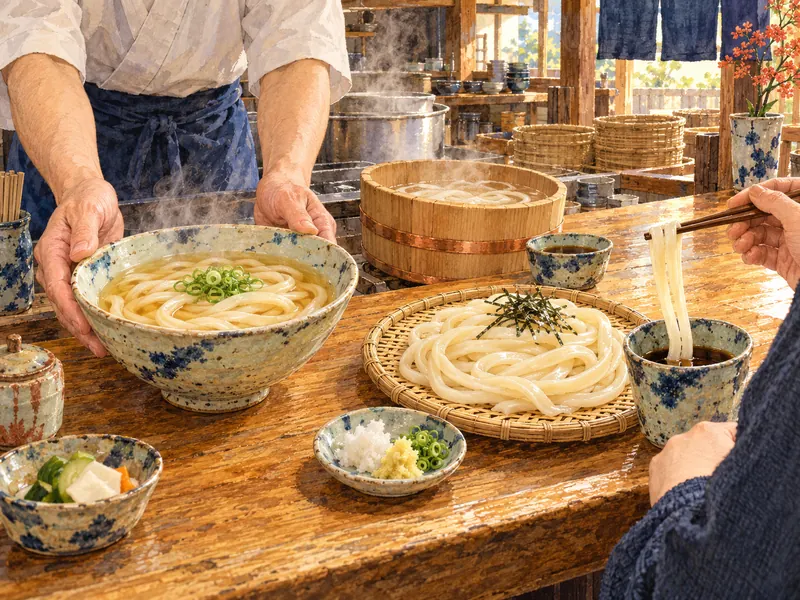
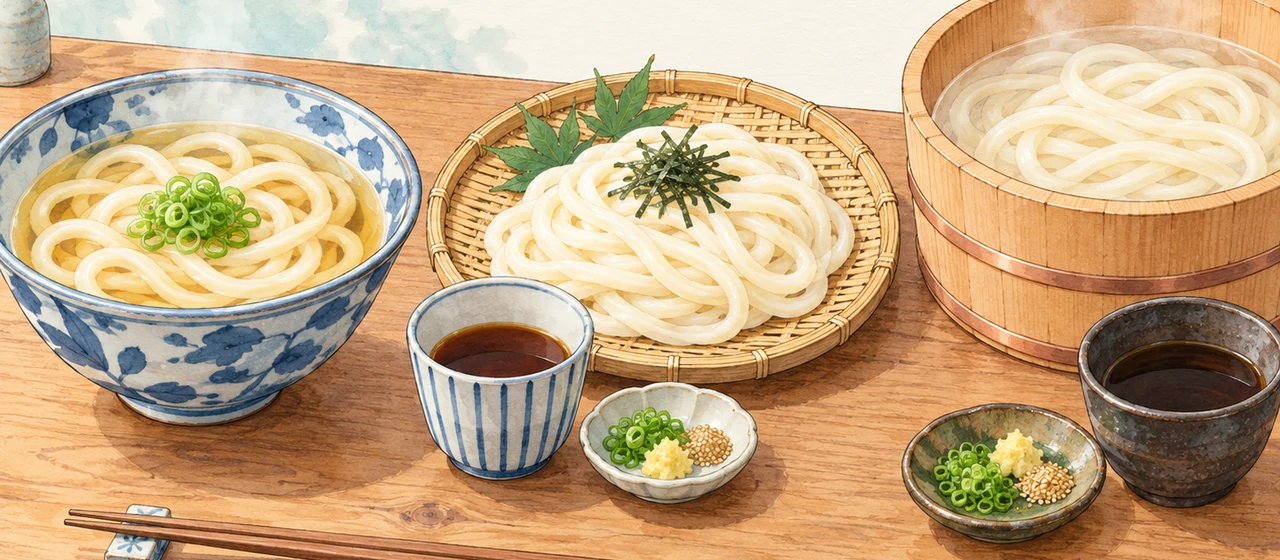
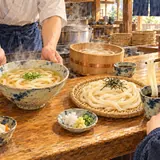
A cook serves hot kake udon beside kamaage while a diner dips cold zaru udon into a separate sauce cup.

Udon noodles are made with wheat flour. Kake comes in broth; bukkake has a more concentrated sauce poured over the noodles. Zaru has cold noodles with a separate dipping sauce. Kamaage has noodles in hot water, also with a separate dipping sauce.

Texture and broth vary by shop and region. Firm noodles are one style; softer udon has its own appeal. Choose what looks enjoyable today rather than looking for one correct version.

Remember this!
  • Check whether to dip the noodles or pour the sauce.
  • The water in a kamaage tub is not the dipping broth.
See the steps and checks
  1. For a bowl of soup, look for kake. For dipping noodles, look for zaru or kamaage.
  2. Check the temperature options and toppings for bukkake. If sauce arrives separately and you are unsure what to do, ask.

Official guidance checked 2 October 2026
2Order temperature & size

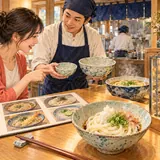
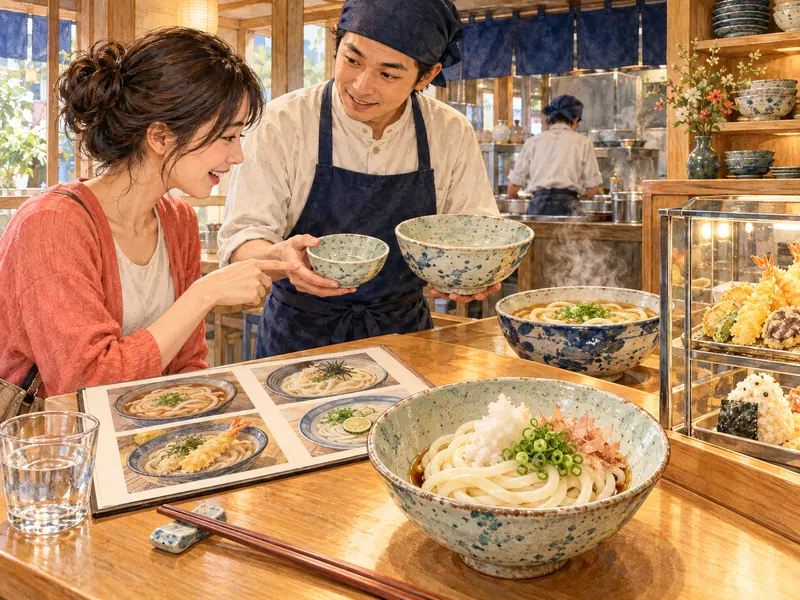
A diner discusses temperature and portion with a server showing two bowl sizes beside a picture menu.

Give the dish name, hot or cold, and the portion size. Shops may use small/medium/large, regular/large, or numbers of noodle portions. The same size name does not guarantee the same amount at different restaurants.

Tempura and rice balls may cost extra. Checking the portion and likely total first helps you choose and helps staff avoid remaking an order. You do not need to add side dishes.

Remember this!
  • Say the dish, temperature and size together.
  • Check the price of toppings too.
See the steps and checks
  1. Example: “Bukkake no tsumetai no o, sho de onegaishimasu” means “Cold bukkake, small, please.” Use the size names on that menu.
  2. Ask “Kono saizu wa dono kurai desu ka?” (How big is this size?), or point to a photo or display.
  3. Some shops offer separate noodle and broth temperatures. Ask whether your preferred combination is available.

Official guidance checked 2 October 2026
3Follow the self-service flow

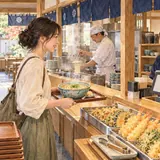
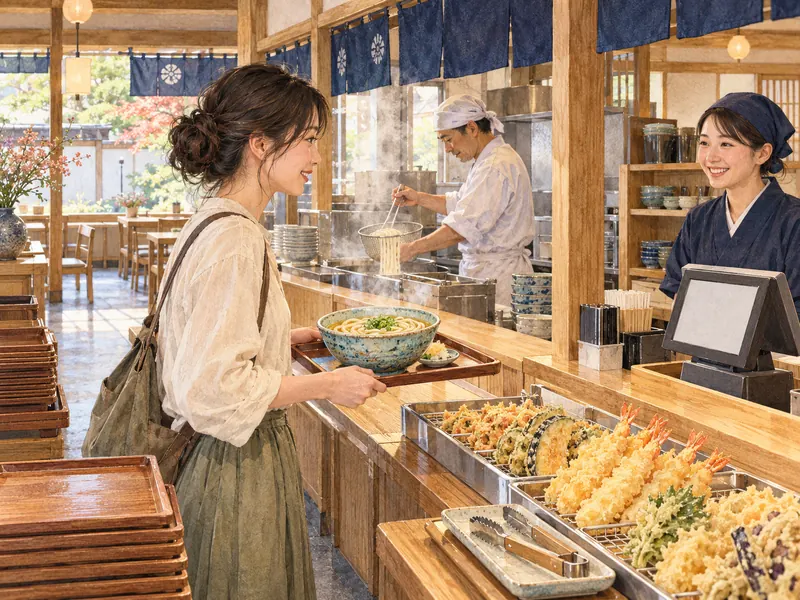
A diner carries a stable udon tray with both hands past the tempura counter toward the cashier.

Some shops take orders at your seat; others have a tray-and-counter line. At self-service shops, locate the ordering, collection and payment points. Where you choose tempura, and whether you add broth yourself, varies by shop.

Other diners can offer clues, but follow signs and staff instructions. If equipment lets you warm noodles yourself, ask before using it when unsure. Take care around the hot water.

Remember this!
  • Check where to order and when to pay.
  • Look for dish-return instructions after eating.
See the steps and checks
  1. One possible flow is tray → order and collect noodles → choose any sides → pay → find a seat. Do not assume every shop follows that order.
  2. Find the water, chopsticks and condiments, and carry hot bowls steadily on the tray.
  3. Return dishes if there is a return counter, following any directions for leftover broth and chopsticks.

Official guidance checked 2 October 2026
4Add condiments gradually

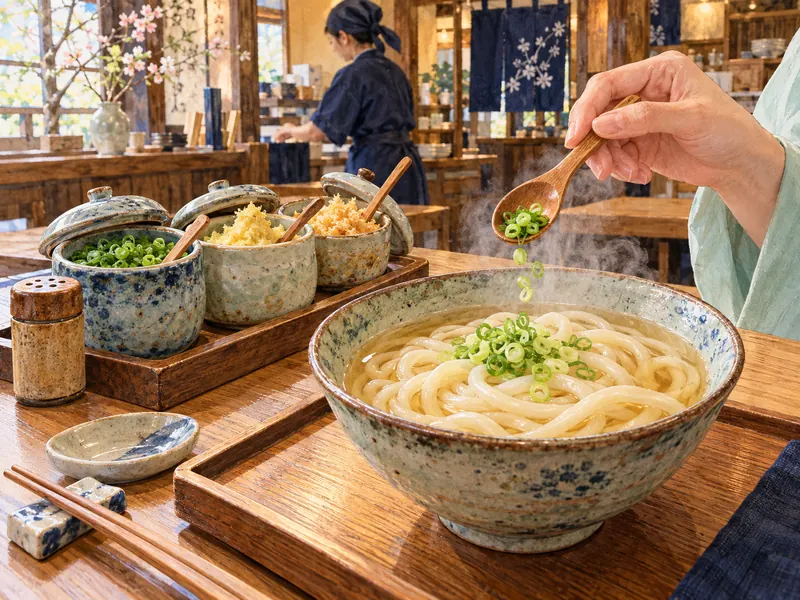
A diner uses a shared serving spoon above the bowl to add a little scallion without touching the udon.

Scallions, ginger, tempura crumbs and chili seasoning are optional ways to adjust the flavor. You do not need all of them. Taste the udon first, then add a little at a time so you can control the flavor and heat.

Availability and charges vary; some toppings require a separate order. Use the shared spoon or tongs, rather than your own chopsticks, so the condiment station stays pleasant for the next person.

Remember this!
  • Taste first, then add a little.
  • Keep shared serving utensils clean.
See the steps and checks
  1. Check which condiments are included and which tempura or toppings cost extra.
  2. Do not return anything from your bowl to a shared container. Keep shared utensils from touching your noodles or mouth.
  3. Check ingredients in condiments, including tempura crumbs, if you have an allergy. See section 6 rather than judging by appearance.

Official guidance checked 2 October 2026
5Eat comfortably & carefully

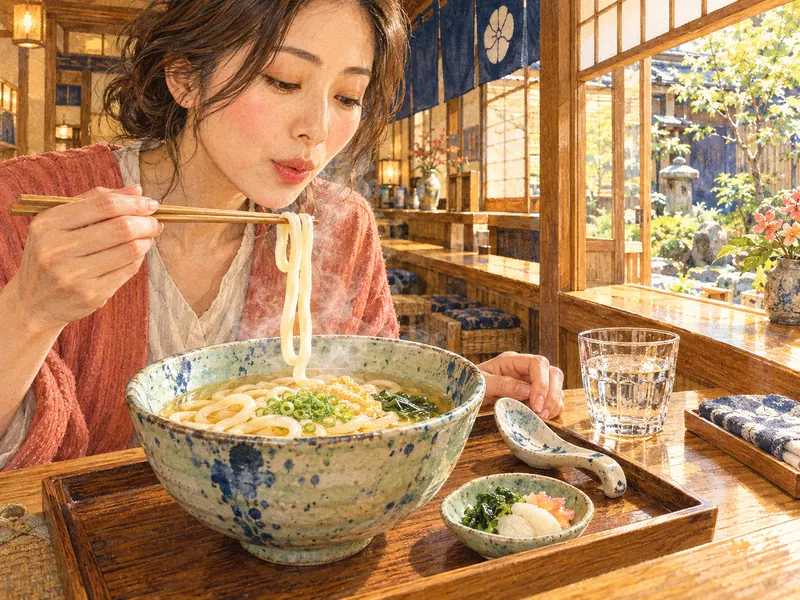
A relaxed diner cools a small bite of hot udon while the heavy bowl stays on its tray.

Slurping is common, but optional. Lift a manageable amount and let hot noodles or broth cool before eating. Take particular care with splash-prone dishes such as curry udon. There is no need to rush.

Eating quickly is not a rule. Leave a heavy or hot bowl on the table and use a comfortable posture. You can ask for a spoon or fork, although not every shop has one.

Remember this!
  • Take small mouthfuls at your own pace.
  • You do not need to finish the broth.
See the steps and checks
  1. It is fine to leave a hot bowl on its tray. Ask staff if you need a different utensil.
  2. For dipping udon, transfer a manageable amount into the separate dipping sauce. Keep kamaage water and dipping sauce distinct.
  3. After eating, follow that shop’s payment and dish-return arrangements.

Official guidance checked 2 October 2026
6Check broth & allergens

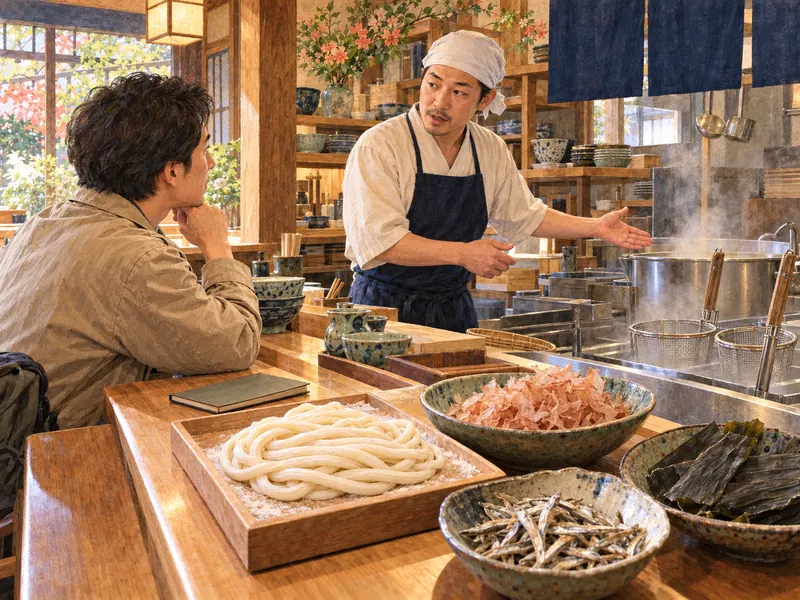
Before ordering udon, a diner discusses broth ingredients and kitchen equipment with the cook.

Ordinary udon contains wheat. Broth may contain fish, sauce may contain soy or wheat, and toppings may include egg or shrimp. Vegetable udon, or noodles without toppings, are not automatically vegetarian or suitable for allergies.

Some restaurants share boiling water or equipment with soba and other foods. Removing a topping may not solve the problem. Explain your requirements before ordering and choose another option if staff cannot confirm suitability.

Remember this!
  • Explain specific ingredients you must avoid.
  • Ask about broth and shared equipment.
See the steps and checks
  1. Clearly distinguish an allergy from a preference: “Komugi arerugii ga arimasu” means “I have a wheat allergy.” A written Japanese card can support the conversation.
  2. Ask staff to check the kitchen: “Does the broth contain fish?” and, when relevant, “Are these boiled in the same water as soba?”
  3. The Consumer Affairs Agency’s communication sheet supports information exchange; it does not guarantee safe food or accommodation.

Official guidance checked 2 October 2026

Back to Japanese food and ingredient checks →

✿ Summary ✿

Choose your style, temperature and portion, then follow that shop’s ordering flow. Add condiments gradually and take care with hot noodles. Explain allergies or foods you avoid before ordering, including questions about broth and shared equipment, so staff can check what is possible.

Enjoy an udon restaurant — an illustrative dining scene