
My Page

Enjoy okonomiyaki — an illustrative dining scene

Regional food & local experiences

Enjoy okonomiyaki

Mixed or layered, each has its appeal.
Explore okonomiyaki and the fun of making it.

✿ What you will learn ✿

Osaka and Hiroshima have different approaches.
Learn how to order, eat and choose a workshop,
then enjoy time around the griddle.

Enjoy okonomiyaki — an illustrative dining scene

✿ Frequently asked questions ✿

Q Is it usually self-cook? +

It depends on the restaurant. Ask before touching the batter; some shops cook for you. In a workshop, follow the instructor.

Q Must I eat directly from the spatula? +

No. Transfer it to a plate and use chopsticks if you prefer. Avoid burns from hot food and metal.

Q Can I take an OKOSTA class in English? +

English classes are advertised, but that does not guarantee every session. Confirm English instruction for your chosen date and course before booking.

1Osaka and Hiroshima styles
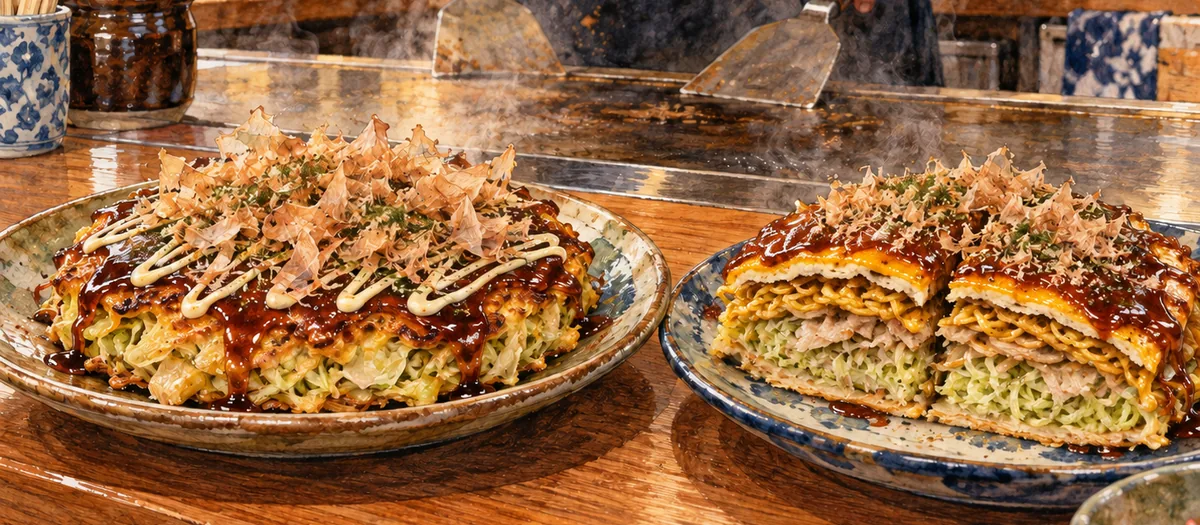
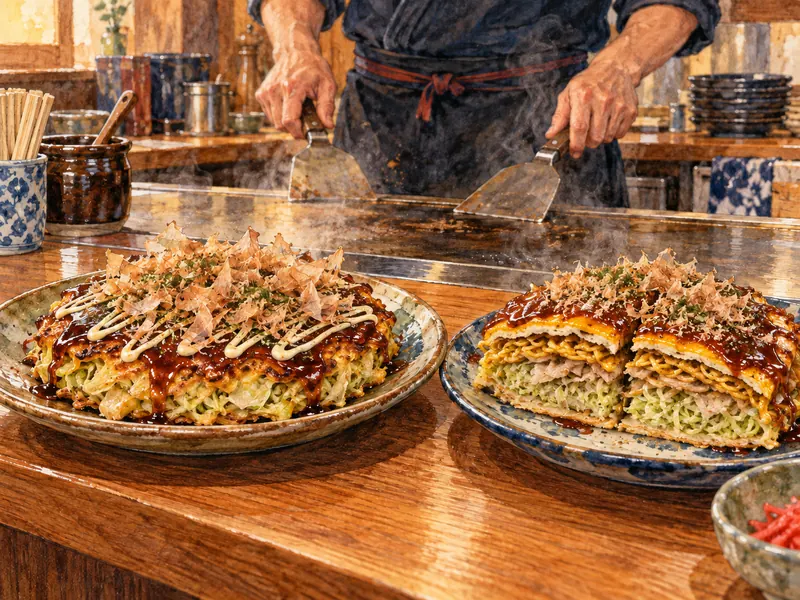
A mixed okonomiyaki and a layered version showing noodles and cabbage.

Osaka is well known for a style that mixes cabbage and other ingredients into batter. Hiroshima commonly layers a thin base with cabbage, meat, noodles and egg. Their layers and textures differ, and individual restaurants also have their own variations.

Noodles do not automatically make it Hiroshima-style: Osaka also has noodle-containing dishes such as modanyaki. Check the description and picture rather than the name alone.

Remember this!
  • Notice whether it is mixed or layered.
  • Both are locally loved ways to enjoy the dish.
See the steps and checks
  1. Read the menu’s description rather than assuming from the city alone.
  2. Choose the noodle type or quantity where the restaurant offers that option.

Official guidance checked 2 October 2026
See the everyday Japanese food guide

2Choose ingredients and ask who cooks

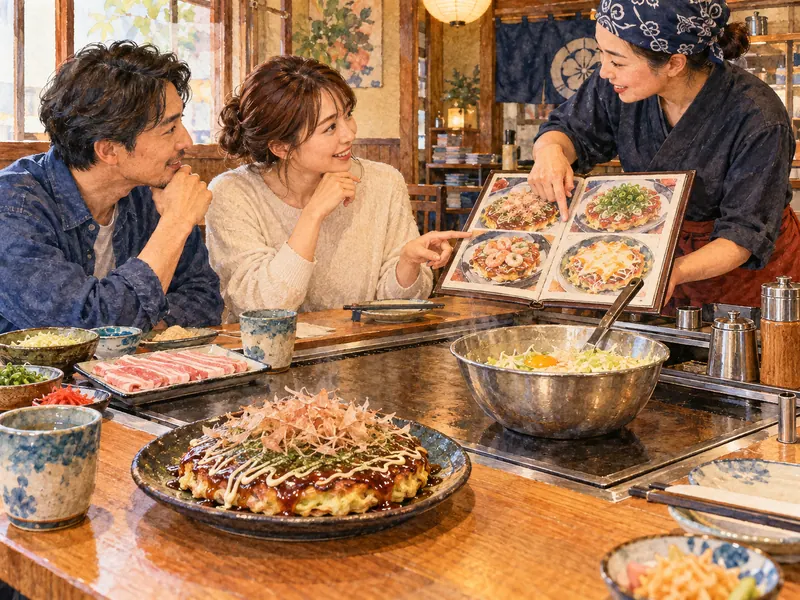
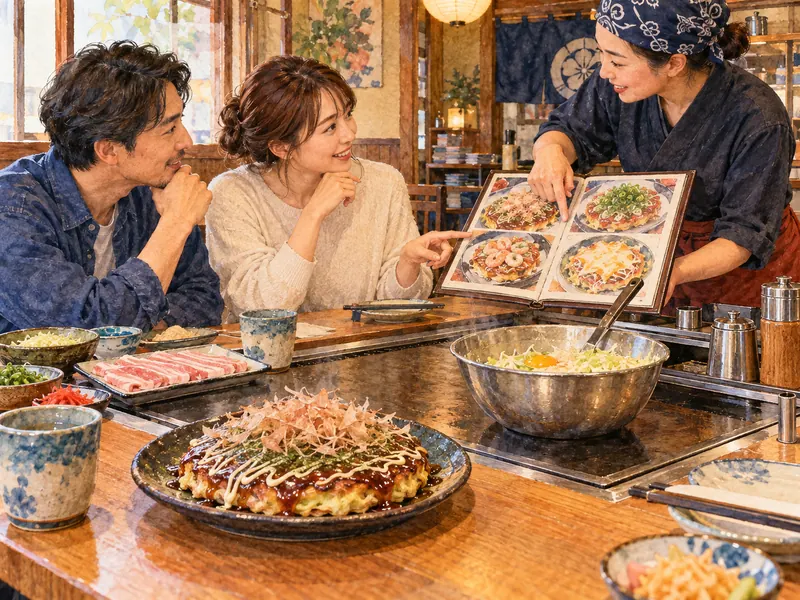
Diners discuss okonomiyaki ingredients beside a mixing bowl and a cooked serving.

Check the ingredients and price of options such as pork-and-egg, squid or mixed fillings. Some restaurants cook for you; others let you cook at the table. Even if a bowl of batter arrives, ask who cooks before starting to mix it.

Request extras or sauce changes early. Once ingredients are mixed, they may be difficult to remove, so distinguish dislikes from allergies when discussing changes.

Remember this!
  • Check ingredients, price and who cooks first.
  • Ask about the size and any sharing rules.
See the steps and checks
  1. If it is your first time, ask staff to explain the cooking method.
  2. Check the total with extra toppings, noodles and drinks.

Official guidance checked 2 October 2026
See the everyday Japanese food guide

3Wait until ready, then portion it

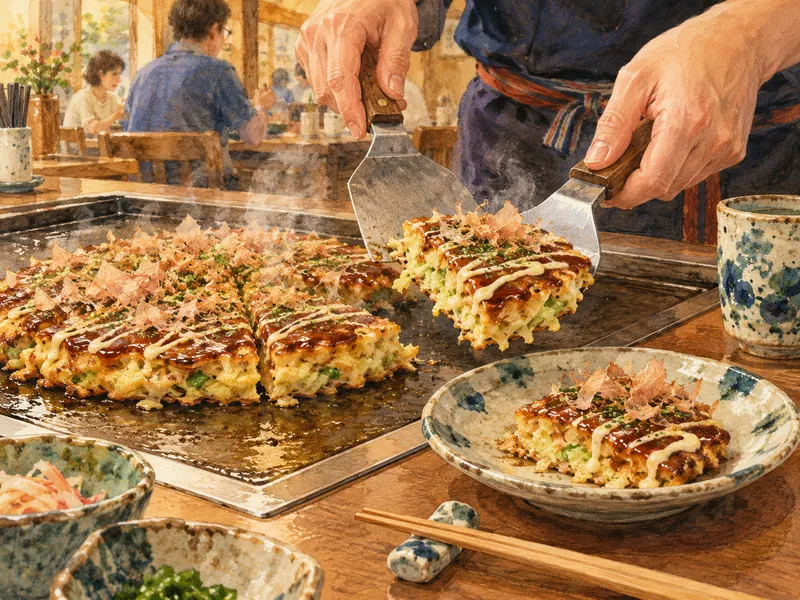
Hands cut cooked okonomiyaki and transfer a portion to a small plate.

Wait until the batter and meat are fully cooked and staff or your instructor indicates it is ready. Cut manageable pieces with a spatula, then use a plate and chopsticks if you prefer. Eating from the griddle is an option, but you need not put a hot spatula to your mouth.

Avoid repeatedly flipping or pressing a dish while staff are finishing it. Follow the house method, and ask early if you need help at a self-cook table.

Remember this!
  • Take a manageable piece and check its heat.
  • A plate and chopsticks are fine.
See the steps and checks
  1. Keep plates and plastic items off the hot griddle unless staff direct otherwise.
  2. Hold the handle, and ensure any utensil touching your mouth has cooled.

Official guidance checked 2 October 2026
See the everyday Japanese food guide

4Try a class at Hiroshima Station

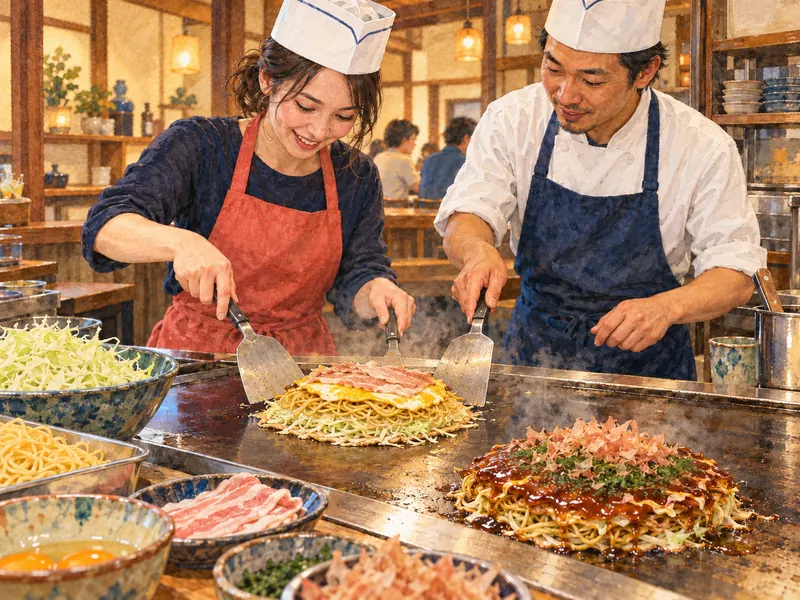
A learner and instructor prepare layered Hiroshima okonomiyaki on a griddle.

Otafuku’s OKOSTA offers a Hiroshima-style workshop using a griddle and spatulas. Learn how to layer cabbage and noodles, then eat what you have made. It teaches a different method from Osaka-style mixed batter, so choose the experience you want.

The English page advertises English classes but also mentions Japanese guidance. Confirm the language of your session explicitly. Booking deadlines also differ between the Japanese and English pages, so avoid relying on a last-minute place.

Remember this!
  • Learn the Hiroshima method with an instructor.
  • Confirm language and children’s conditions when booking.
See the steps and checks

An experience to try there

Official information checked 2 October 2026. Live availability has not been checked. Reconfirm prices, operation and conditions before booking. Images are illustrative and do not depict the exact venues.

Hiroshima Station OKOSTA: standard cooking experience

Make and eat layered okonomiyaki; reference price ¥2,500. Special-diet menus exist, subject to individual checks.

Location
Inside ekie, 1-2 Matsubara-cho, Minami-ku, Hiroshima; two minutes from Hiroshima Station’s north exit.
Booking
Reservation required. Book ahead and reconfirm deadlines, which differ between language pages.
Duration
The standard course is 90 minutes.
Language
English classes are advertised; request and confirm the language for your date.
Children
One guardian per child in Japanese primary-school grades 1–4. Confirm guardian bookings and preschool participation.
  1. Even for a dietary menu, confirm ingredients and shared-griddle handling individually.
  2. Read the current cancellation fees and arrival time for the selected booking.

Official guidance checked 2 October 2026
Compare the regions and plan your trip

5Check flour, stock and shared griddles

An okonomiyaki table where diners consult staff about batter and ingredients.

Check beyond the visible fillings: wheat, egg, yam, seafood, sauces and mayonnaise can all matter. Removing pork may leave animal ingredients in stock or tempura crumbs. For an allergy, discuss shared griddles and spatulas as well.

Vegetarian, Muslim-friendly and gluten-free mean different things. Do not assume any one label meets your needs; explain the specific ingredients and preparation requirements.

Remember this!
  • Check batter and equipment as well as toppings.
  • Do not eat on an unconfirmed assumption.
See the steps and checks
  1. Keep utensils for raw meat separate from those for cooked food.
  2. Keep sleeves and children’s hands away from the hot surface.

Official guidance checked 2 October 2026
See the everyday Japanese food guide

6Compare noodles, fillings and finishes

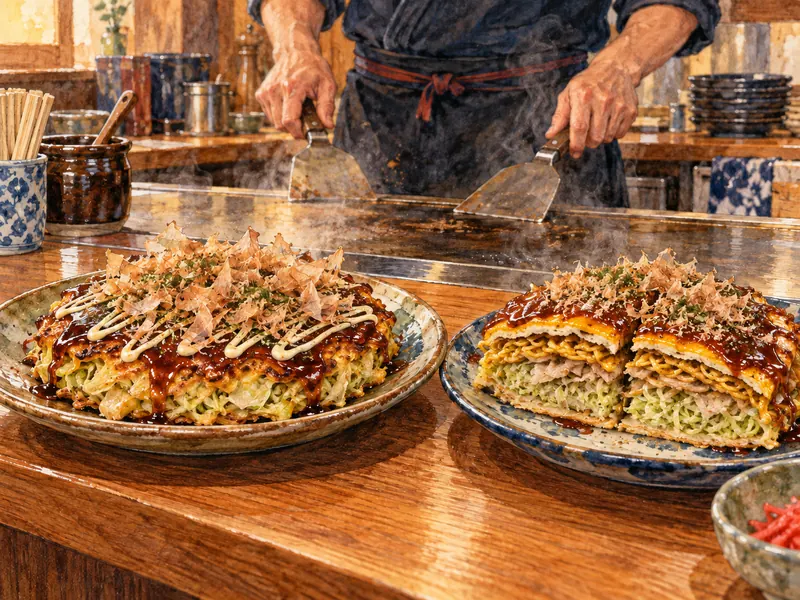
Osaka mixed and Hiroshima layered okonomiyaki on a restaurant counter.

Batter, cabbage, fillings, sauces and noodles all change the result. Differences exist between shops in the same city as well as between Osaka and Hiroshima. Before adding more sauce, try a little of the restaurant’s finished version.

You do not need to correct someone else’s eating style. Follow the restaurant’s safety guidance and use utensils that work comfortably for you.

Remember this!
  • Enjoy regional and individual restaurant differences.
  • Ask about portion size before ordering.
See the steps and checks
  1. For noodle versions, check which noodles are offered.
  2. Deciding on an extra pancake after eating helps manage the quantity.

Official guidance checked 2 October 2026

See the everyday Japanese food guide

✿ Summary ✿

Check the house method, ingredients and portion, then wait until fully cooked and divide it comfortably. Enjoy Osaka’s mixed style and Hiroshima’s layered style on their own terms. For a workshop, confirm age, language and dietary needs in advance, including shared-griddle arrangements.

Enjoy okonomiyaki — an illustrative dining scene